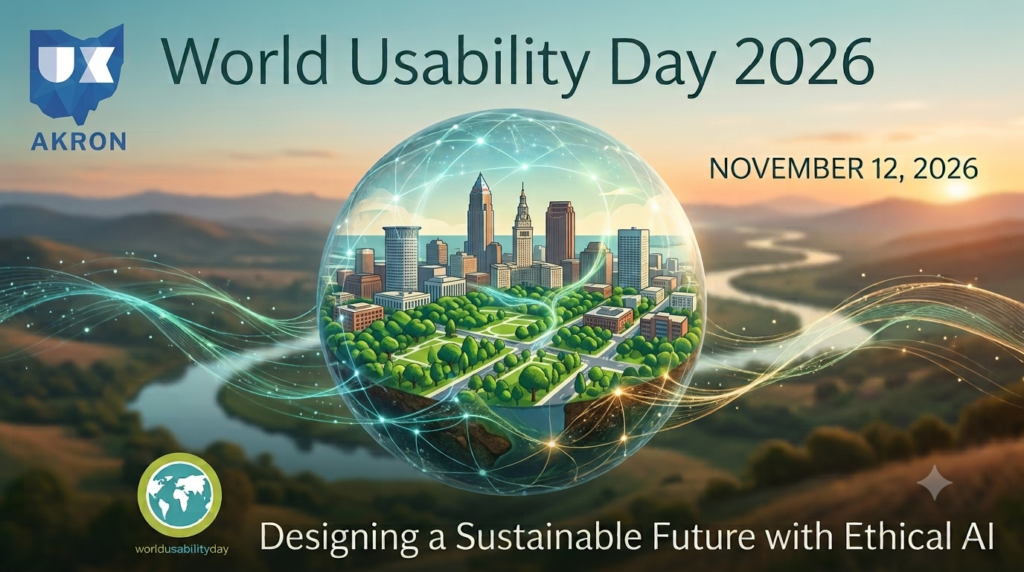
World Usability Day 2026 is happening on Thursday, November 12, 2026! This year’s theme is: “Designing a Sustainable Future with Ethical AI”.
The theme explores how ethical artificial intelligence can strengthen global collaboration to build a sustainable and equitable future. It casts a vision towards technology ecosystems where AI not only optimizes systems, but also includes shared human values that promote environmental stewardship, social equity, and collective well-being.
Learn more about WUD2026 theme
🗓 Date: Thursday November 12, 2026
📍 Location: Simon and Rose Mandel Theater Lobby: Tri-C East Campus, Highland Hills, OH
⏰ Event hours: 9:30 am to 4:00 pm
Continental breakfast and lunch will be served.
Save your seat!
Volunteer to help with WUD2026
Looking to get involved? We’d love your help with organizing, promoting, or operations during the event!
Speakers
Nick Dauchot
Cutting Tokens, Cutting Carbon: The Business Case for Lean AI Design
Designing with AI is unique in that environmental and financial sustainability can both be supported when applying AI in a lean and effective way. If your product minimizes its use of tokens and focuses AI usage on core features without bloat or unnecessary usage, businesses can mitigate Scope 2 Co2e (indirect energy emissions, carbon dioxide equivalent) while at the same time mitigating their operational expenses for consuming AI tokens. This presentation will go through three practical techniques that designers can use to create more usable and sustainable AI interfaces.
About Nick
Nick is a native Clevelander and Lead Designer at Grand Studio, a boutique design agency based out of Chicago that specializes in research, experience design, and user interfaces. Nick has been a digital experience designer for 10 years and has an M.S. in UXD from Kent State University, and is nearing completion of an MBA at Case Western Reserve University where he took courses on Environmental Sustainability and Artificial Intelligence. He spent four years working as a Lead in a global healthcare company’s supply chain division creating new digital experiences. Today, Nick works in enterprise at the intersection of artificial intelligence and design systems, understanding how teams are using AI in their process, and identifying opportunities to help organizations large and small use and scale AI in meaningful and sustainable ways.
Sadukie Dutkiewicz
Beyond the Prompt: Ethical UX Patterns and Cloud Architectures for Human Dignity
When AI fails, it’s rarely just a bad prompt – it’s usually a fundamental system flaw. AI systems that hallucinate, make biased assumptions, or burn massive compute resources on simple tasks aren’t just technical headaches;they erode trust, alienate diverse users, and waste energy.
So, how do we build AI applications that actually protect human dignity, respect cultural nuances, and stay environmentally responsible?
As developers and software architects, we can’t treat ethics as an afterthought or leave it solely to policy documents. It has to live in our software design, our UI components, and our deployment pipelines.
In this session, we’ll look at responsible AI through a practical system design lens. We’ll answer:
– Why should we care? How underlying system decisions directly impact user autonomy, inclusion, and carbon footprints.
– How do we implement it? Practical UX and architectural patterns – like progressive disclosure, confidence scoring, model right-sizing, and semantic caching – that keep systems lean and human-centered.
– What specific tools can help? How to leverage native responsible AI and carbon-tracking tools built directly into Microsoft Azure, AWS, and Google Cloud Platform.
Whether you’re writing code, designing interfaces, or mapping out system architectures, you’ll leave with concrete strategies to audit your tech stack and build AI systems that honor both people and the planet.
About Sadukie
Sadukie is a tech polyglot who brings code to life and helps others unlock their potential through teaching and mentorship. As a seasoned software architect with deep expertise in user experience and human-centered design, she translates UX principles directly for developers—making it easy for engineering teams to build intuitive, user-first software and hit the ground running.
When technical or design roadblocks pop up, she’s the one who clears the path—breaking down complex ideas and helping teams communicate more effectively. A natural connector and strong community advocate, Sadukie loves bringing people together across the tech world. Whether she’s mentoring, speaking, coding, or juggling life’s adventures, her mission stays the same: to make tech and UX more approachable and spark confidence in every developer’s journey.
Jason Hong
The Promise and Peril of AI for Products
The goal of this talk is to give realistic expectations about the potential of AI, its limitations, common misconceptions, ethical issues, and significant risks that product teams and management need to be aware of. This talk will help product managers, UX designers, and developers navigate the hype, better understand the underlying context that AI systems operate in, and make more responsible and effective product decisions.
This talk is based on Professor Hong’s and his colleagues’ research at Carnegie Mellon University, as well as courses taught there on UX Design and Responsible AI.
About Jason
Jason Hong is a professor emeritus in the Human Computer Interaction Institute, part of the School of Computer Science at Carnegie Mellon University. His research is in the areas of mobile computing, usable privacy and security, and responsible AI. He is an ACM Fellow, a member of CHI Academy, and co-founded startups Wombat Security Technologies and fuguUX.
Greg Miller
Prove You're Human: What AI Bot Detection Costs Disabled Users
Somewhere between you and the thing you came to do, a system is deciding whether you are a person. It watches how you move your mouse, how fast you type, how your session behaves. If you look wrong, it asks you to prove yourself.
That system is increasingly AI, and it is under pressure. Modern bots pass visual challenges and slip past web application firewalls, so detection escalates: more signals, more friction, more invisible judgment about who is real. The people who fall out of the bottom of that arms race are the ones who navigate differently. Keyboard-only users. Screen reader users. Anyone whose motor control does not match the training data.
This talk looks at what AI-driven bot detection actually costs disabled users, using real attack patterns and real failures. We will work through CAPTCHAs, aggressive session timeouts, and custom OTP fields, then ask whether passkeys and WebAuthn offer a way out or just move the problem.
What attendees will take away:
– How modern bots defeat CAPTCHAs and firewalls, and why that failure pushes detection toward behavioral analysis
– The specific accessibility breakages in common authentication patterns: split OTP inputs, timed sessions, motion-based challenges
– Why “”prove you’re human”” is an ethics question and not only a security one
– What passkeys and WebAuthn actually change, and what they leave unsolved
About Greg
Greg Miller is a UX engineer, web developer, and accessibility specialist based in Toledo, Ohio. As founder of Shrinkray Interactive and Engineering Lead for Compass Detroit, he architects modern web platforms using React, Astro, TypeScript, and headless content management systems like Sanity. His technical practice emphasizes semantic architecture, robust design systems, and strict WCAG AA compliance. His work on regional public platforms and developer conferences has earned multiple ADDY and Mosaic awards for technical and inclusive design.
Beyond client engineering, Greg organizes developer tech events through GDG Toledo and serves on the board of directors for Kool Kat Science and Toledo Codes. His background bridges a Master of Education in Instructional Design with a Bachelor of Science in Product Design from Bowling Green State University, shaping an engineering approach focused on usability, clarity, and scalable component systems.
Missy Williams
Human-Centered Content in an AI Search World
AI makes it tempting for companies to mass-produce content and let AI tools do the heavy lifting. But a content strategy built that way blends in, adds nothing new, and risks hurting visibility. You can still use AI, but with guardrails.
Learn how to keep your content human-centered and useful to your readers while using AI to assist with research, planning, and editing. We’ll also cover what kinds of content earn visibility in both AI tools and search results, and how to make your content more likely to be cited.
About Missy
With over 25 years of overall marketing experience, Missy Williams has a diverse background that has grown alongside changes in technology and marketing trends. As owner and digital strategist of Missy Williams Digital, a digital marketing agency focused on SEO, content, and analytics, she helps small businesses get more visibility online to grow revenue. While leveraging available technology, she takes a human-centered approach to marketing, always keeping the person on the other side of the screen in mind to create experiences that engage people across digital touchpoints.
Missy’s career includes marketing experience in Northeast Ohio and Los Angeles, spanning across industries from entertainment to consumer goods and more. She is the youngest of 10 kids, and outside of her work, she loves spending time with her nieces and nephews, watching sports, hiking, participating in grassroots activism and community volunteering, and gardening. Missy views her SEO strategies much like gardening, where she plants seeds and nurtures them to grow, yielding long-term results that continue to produce over time.
Agenda
9:30 AM to 10:00 AM
Registration, Breakfast, Welcome
10:00 AM to 11:00 AM
Speaker: Sadukie Dutkiewicz
Beyond the Prompt: Ethical UX Patterns and Cloud Architectures for Human Dignity
11:00 AM to 11:15 AM
Break
11:15 AM to 12:15 PM
Speaker: Jason Hong
The Promise and Peril of AI for Products
12:15 PM to 1:30 PM
Lunch Break
1:30 PM to 1:45 PM
Sponsor Announcements/ Giveaways
1:45 PM to 2:15 PM
Speaker: Missy Williams
Human-Centered Content in an AI Search World
2:15 PM to 2:45 PM
Speaker: Greg Miller
Prove You’re Human: What AI Bot Detection Costs Disabled Users
2:45 PM to 3:00 PM
Break
3:00 PM to 4:00 PM
Speaker: Nick Dauchot
Cutting Tokens, Cutting Carbon: The Business Case for Lean AI Design
WUD2026 Sponsor
We are grateful to Cuyahoga Community College, School of Creative Arts for serving as our event sponsor and venue partner.
